
The "Paper 51%" Trap: Why Legitimate Joint Ventures Are Being Flagged for "Fronting" in 2026
Is your Joint Venture flagging "Fronting" risks? Discover why the Local Content Secretariat targets JVs with foreign digital footprints and how to build a 51% Sovereign Compliance Portal.
The ink is dry on the shareholder agreement
You gave 51% equity to a Guyanese partner. You appointed a local Director. You think you are compliant.
But when the Local Content Secretariat (LCS) auditors look at your digital footprint, they see a different story. They see a company that lives in Houston, not Georgetown.
In the 2026 audit cycle, legal paperwork is no longer enough. The LCS has begun using "Digital Signal Intelligence" to identify "Rent-a-Citizen" schemes. If your website, email servers, and data residency scream "Foreign Controlled," your 51% Guyanese ownership is viewed as a sham.
This is the Digital Sovereignty Gap. And it is the primary reason why legitimate JVs are losing their Local Content Certificates.
The "Fronting" Signals You Are Broadcasting
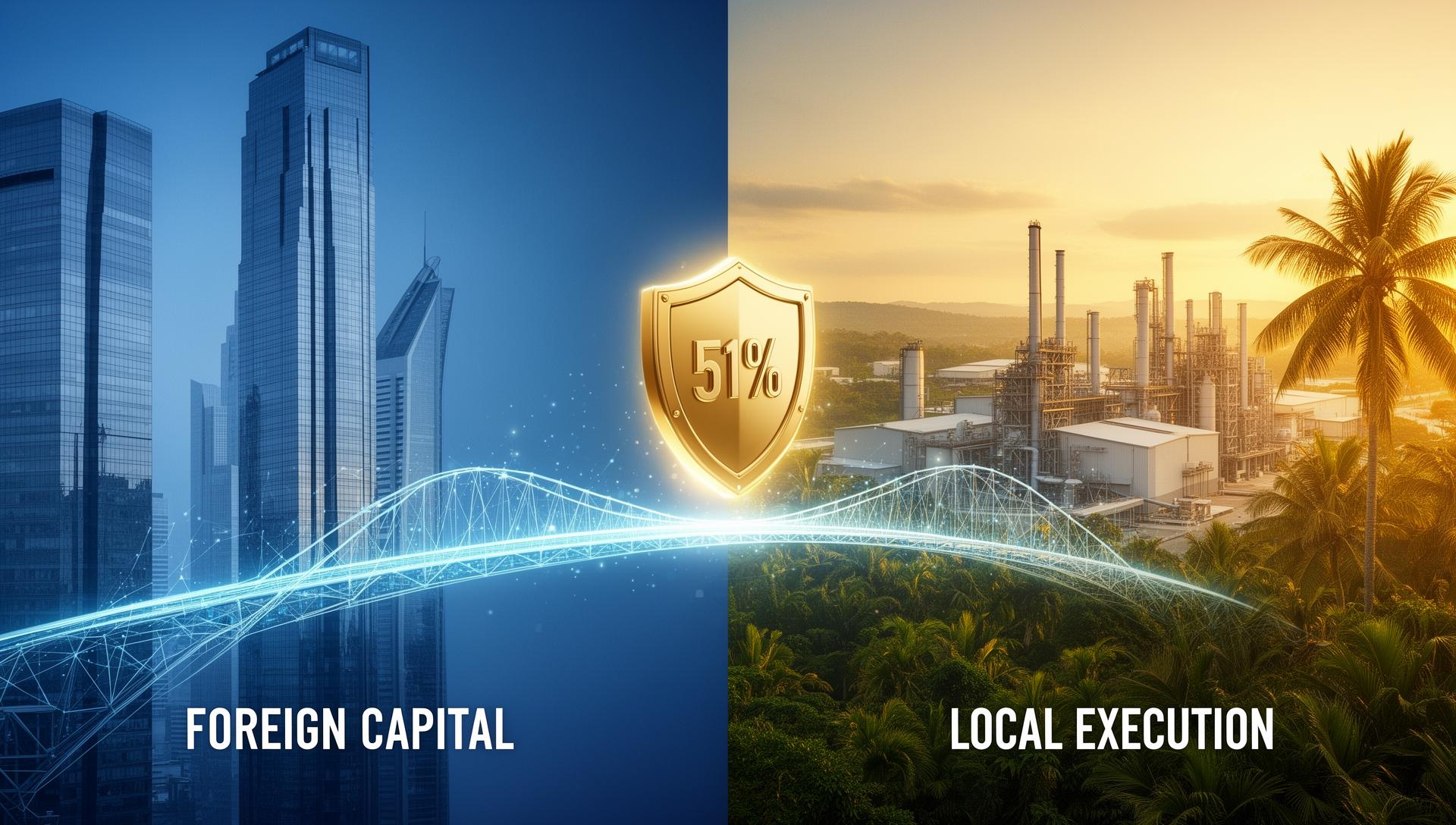
A Joint Venture (JV) is supposed to be a marriage of Foreign Capital and Local Execution. But most JVs make a critical mistake: They clone the Foreign Parent's website.
Here is the scenario that triggers an audit:
The Claim: "We are 'Guyana-Tex Logistics Inc.', a majority Guyanese company."
The Digital Reality:
- The website is a sub-domain of the US parent (guyana.texaslogistics.com).
- The hosting IP address is in Dallas, Texas.
- The "Our Team" page lists 12 Americans and 0 Guyanese nationals.
- The contact form routes to a US sales team.
The Auditor's Verdict: This is not a local company. This is a foreign branch office wearing a "Guyanese mask." Result: Certificate Denied.
The Solution: The "51% Digital" Rule
To survive the new scrutiny, your digital infrastructure must mirror your legal structure. You need Digital Sovereignty.
At Website.gy, we engineer Compliance Portals specifically for Oil & Gas JVs. We ensure your digital assets prove your "Effective Control" is local.
1. Sovereign Hosting & Jurisdiction
We do not host your JV site on your US Parent's GoDaddy account. We deploy it on Sovereign Cloud Architecture with a .gy domain dominance.
The Signal: When the LCS runs a WHOIS or IP check, they see a digital entity that "lives" in Guyana, independent of the foreign parent.
2. The "Local Workforce" Visibility Layer
You cannot hide your local staff. Our JV portals feature a dynamic "Local Capacity" Dashboard.
Instead of generic stock photos, we build a "Meet the Local Team" section that highlights your Guyanese engineers, drivers, and admin staff.
Why it works: It proves Human Capital Development—a key pillar of the Act.
3. The "Supply Chain" Data Vault
Auditors want to know where your money is going. We integrate a "Vendor Portal" where local Guyanese suppliers can register and bid.
The Win: This proves you are actively soliciting local vendors (required by law), rather than just importing everything from the US parent's supply chain.
The "Dual-Identity" Architecture
We understand the complexity. The Foreign Parent needs to show global investors a unified brand. The Local Entity needs to show the Government a sovereign brand.
We solve this with "Dual-Identity Architecture."
Global View: The site aligns with the Foreign Parent's branding guidelines (fonts, colors) to satisfy global investors.
Local View: The architecture, data, and content strategy are legally distinct to satisfy the Local Content Act.
The $12,500 Insurance Policy
A Local Content Certificate is the key to multi-million dollar Exxon contracts. Losing it costs you everything. Building a Sovereign JV Portal costs less than one week of a consultant's time.
Do not let a "Template Website" be the reason your JV is labeled a shell company. Legitimacy must be visible.
Continue Your Research
2026 Local Content Audit: Is Your Website a "Fronting" Risk?
The Local Content Secretariat is now cross-referencing digital footprints with legal filings. Discover the 3 website red flags that trigger a 'Fronting' investigation.
SecurityExxon & Hess Vendor Protocols: The Cybersecurity Checklist for Local Partners
Major operators require Tier-1 digital security. See the 5-point checklist your website must pass to survive the Vendor Risk Assessment (VRA).