
The Ariba Barrier: The Definitive Guide to Machine-Readable Vendor Profiles
Why SAP Ariba, Coupa, and Oracle Procurement bots reject "Dead Documents"—and how to engineer a "Live Asset" that forces them to index you.
1. The Crisis: The "Black Box" of Procurement — Why You Are Invisible
There is a fundamental misunderstanding in the Guyana Energy Sector about how contracts are awarded. You believe a human Procurement Officer opens your email, reads your PDF, and decides if you are qualified.
The Reality
Tier-1 operators (ExxonMobil, Hess, SBM Offshore, Halliburton) receive 5,000+ vendor applications annually. Humans do not filter this volume. Algorithms do.
They use "Supplier Lifecycle Management" (SLM) platforms like SAP Ariba and Coupa. These systems operate on a simple principle: Search Relevance. When a Logistics Manager needs a "Hazardous Waste Transporter," they type those keywords into Ariba. The system scans the database and returns a ranked list of 10 vendors.
- If you are Rank #1-10: You get the Request for Quotation (RFQ).
- If you are Rank #500: You remain "Unopened."
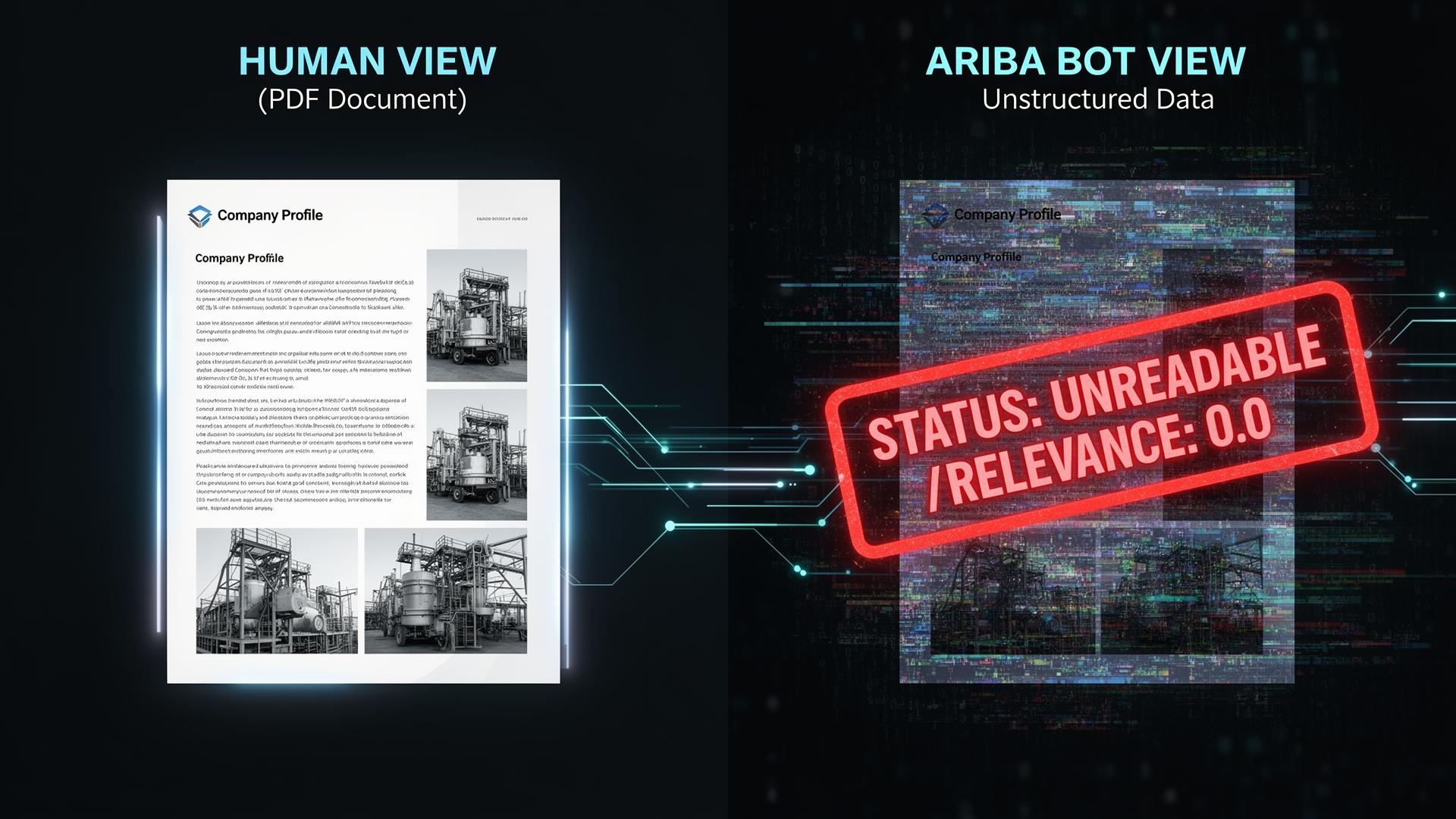
The Crisis: 90% of local companies are invisible to this search engine because their data is locked inside a PDF Capability Statement.
2. The Mechanism: The Physics of Rejection — "Blob Storage" vs. "Structured Data"
To a human, a PDF is a document. To a database, a PDF is a BLOB (Binary Large Object).
When you upload a PDF to a vendor portal:
1. The Storage Phase: The system stores your file in a "Document Repository."
2. The Indexing Phase (The Failure Point): The system attempts to read what you do.
The OCR Gamble
The system runs Optical Character Recognition (OCR) to scrape text. If your PDF has fancy graphics, columns, or "artistic" fonts, the OCR fails. It reads "Logistics Services" as "L0g1st1cs Srvcs" or misses it entirely.
The Context Blindness
Even if it reads the word "Catering," it doesn't know the context. Did you buy catering, or do you sell catering?
The Result: Your profile remains labeled as "Unstructured Data." When the search query runs, you have a Relevance Score of 0.0.
3. The Solution: The "Live Capability" Architecture
To beat the bot, you must stop sending "Images of Text" and start sending "Code."
The "God Mode" strategy used by top international contractors is the Live Capability URL. Instead of attaching a file, you submit a link to a Sovereign Digital Asset (e.g., www.yourcompany.gy/capabilities).
Why This Forces the System to Index You
When an Ariba crawler hits your "Live URL," it doesn't need to guess. It reads the Semantic HTML5 structure of the page. We engineer your site using Schema.org Microdata, which tags every piece of information with a label the robot understands.
The Code-Level Difference
What the Human Sees: "We are ISO 9001 Certified."
What the Ariba Bot Sees (On a Sovereign Website):
<div itemscope itemtype="http://schema.org/Organization"> <span itemprop="certification">ISO 9001:2015</span> <span itemprop="serviceType">Hazardous Waste Management</span> <span itemprop="areaServed">Georgetown, Guyana (Region 4)</span></div>Because the data is Structured, the bot indexes you with 100% Accuracy. You jump from "Invisible" to "Tier-1 Match."
4. The Universal Language: UNSPSC Integration

This is the "Secret Weapon" that separates small local firms from global partners. The Global Supply Chain does not use English words; it uses the United Nations Standard Products and Services Code (UNSPSC).
If your website says "Trucking," you are hoping the procurement officer types "Trucking." If they type "Road Cargo," you lose.
The Fix: We map your services to the specific 8-digit UNSPSC codes used by Exxon and Hess. We embed these codes into the Meta-Tags of your website.
The "Guyana Local Content" UNSPSC Cheat Sheet
(Bookmark this table for your web developer)
| Local Content Sector | UNSPSC Code | |
|---|---|---|
| A. Accommodation & Office Support | ||
| Accommodation Services (Apts/Houses) | 90111500 | |
| Rental of Office Space | 80131500 | |
| Laydown Yard Facilities | 78141500 | |
| Storage Services (Warehousing) | 78141600 | |
| Janitorial and Laundry Services | 76110000 | |
| Catering Services | 90101603 | |
| Food Supply | 90101500 | |
| Pest Control / Exterminator | 72102100 | |
| B. Logistics, Transport & Equipment | ||
| Transportation (Trucking/Personnel) | 78101800 | |
| Cargo Management & Monitoring | 78141501 | |
| Customs Brokerage Services | 78141502 | |
| Aviation Support Services | 78111800 | |
| Manpower and Crewing | 80111600 | |
| Equipment Rental (Crane/Machinery) | 80141600 | |
| Dredging Services | 72141702 | |
| Export Packaging/Crating | 24121500 | |
| Ship and Rig Chandlery | 25110000 | |
| C. Professional Services | ||
| Local Accounting Services | 84110000 | |
| Local Legal Services | 80120000 | |
| Local Insurance Services | 84130000 | |
| Local Marketing & Advertising | 82101800 | |
| Administrative Support | 80161500 | |
| Immigration Support Services | 80121700 | |
| Work Permit / Visa Applications | 93141700 | |
| Medical Services | 85121600 | |
| D. Industrial & Engineering | ||
| Engineering and Machining | 81100000 | |
| Construction Work (Buildings) | 72110000 | |
| Structural Fabrication | 73181600 | |
| Pipe Welding (Onshore) | 73181900 | |
| Pipe Sand Blasting & Coating | 73181100 | |
| Borehole Testing Services | 71161600 | |
| Surveying | 81151600 | |
| Environment Services & Studies | 77100000 | |
| Metrology Services | 81141504 | |
| Waste Management (Hazardous) | 76121900 | |
| Waste Management (Non-Hazardous) | 76121500 | |
| Ventilation (Commercial/Industrial) | 72151200 | |
| Industrial Cleaning (Onshore) | 76111500 | |
| Security Services | 92121500 | |
| ICT - Network Installation | 81111800 | |
(Data Engineering Note: These codes represent the standard "Segment-Family-Class-Commodity" hierarchy used by Tier-1 Procurement systems.)
The Strategy: By embedding UNSPSC 78101800 into your digital DNA, you become "Search Term Agnostic." Whether they search for "Trucking," "Haulage," or "Logistics," the code ensures you appear.
5. The "Hybrid Submission" Protocol
We do not advocate abandoning the PDF entirely (humans still like them). We advocate a Hybrid Submission Strategy for 2026 Tenders:
1. The "Hook" (Field: Website URL): Paste your Live Capability URL (www.yourcompany.gy/capabilities). This is for the Bot. It ensures you get indexed and ranked.
2. The "Proof" (Field: Attachments): Upload your PDF Capability Statement. This is for the Human (once the bot has found you).
6. CEO's Executive Directive
In the age of AI procurement, Legibility is Liquidity. If the machine cannot read you, the corporation cannot pay you.
Your PDF is a "Dead Document." It cannot update itself. It cannot talk to APIs. It cannot be indexed. Your Website is a "Live Asset." It speaks UNSPSC. It structures data. It demands to be seen.
Action Item: Does your current web developer even know what a UNSPSC code is? If not, you are building a brochure, not a business tool. Request a "Schema & UNSPSC Audit" from the Secretariat Digital Desk today.
Reference: SAP Ariba - Supplier Lifecycle Management Documentation
Reference: United Nations - UNSPSC Code Classification System
Continue Your Research
2026 Local Content Audit: Is Your Website a "Fronting" Risk?
The Local Content Secretariat is now cross-referencing digital footprints with legal filings. Discover the 3 website red flags that trigger a 'Fronting' investigation.
SecurityExxon & Hess Vendor Protocols: The Cybersecurity Checklist for Local Partners
Major operators require Tier-1 digital security. See the 5-point checklist your website must pass to survive the Vendor Risk Assessment (VRA).